


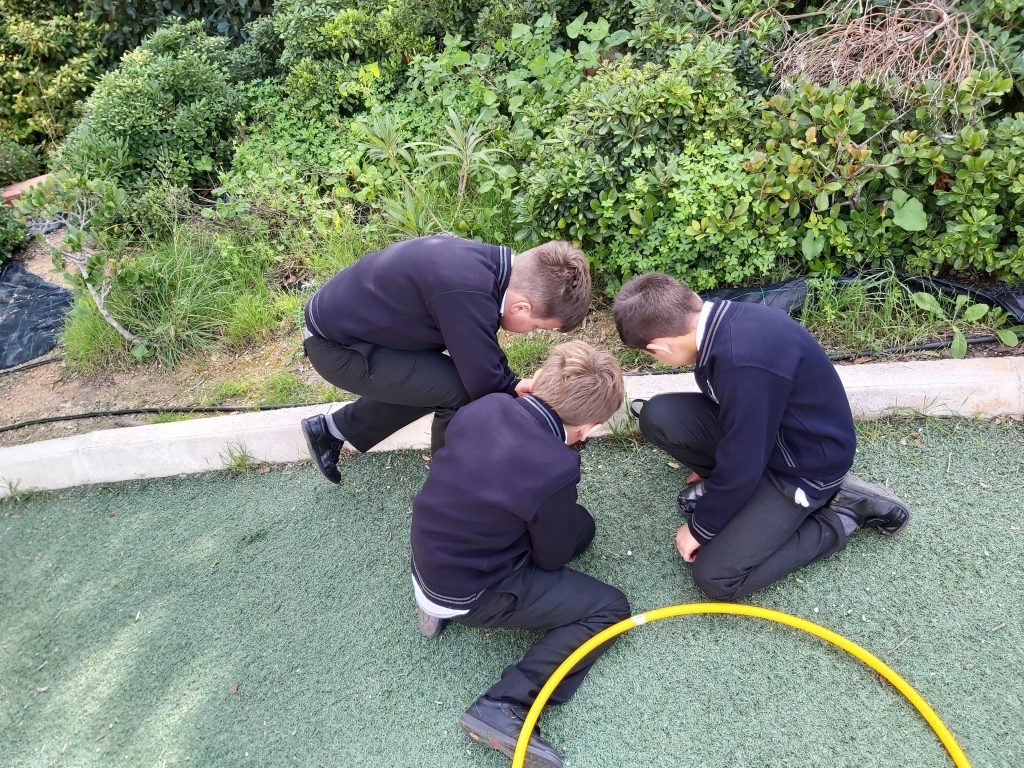
contributed by Ms Bernice Buttigieg, Year 4.1
As part of our Science programme, students learn about habitats, in this case, of insects on our outdoor school campus. The term ‘habitat’ refers to the place where a living organism lives. We had a discussion in class before going outside on the turf area so that boys would know what they need to find out and what to look out for.
As part of the investigation, we used some tools including hand-held magnifying lenses so that students could observe the insects in more detail and also identify them better within their habitat. We also used hoops so that students could investigate different particular areas, such as near bushes, on the pathway, on the turf, etc. and also observe how ‘crowded’ that area was with insects, and with what type of insects. The boys were split into groups and each group wrote their findings on a notebook. Various team roles were assigned, such as recording findings, moving the hoop and observing with the magnifying glass. Rotation of roles was also encouraged.
Apart from engaging in a fruitful scientific activity, the students enjoyed their hands-on task outdoors. Their level of participation increased and their team work was evident as well as their excitement! It was also a great opportunity to breathe in fresh air and to break the classroom routine.
In the end, all the students gathered in a circle to share their findings and they were very keen to do so. They found out that the bee was the most common insect, while they also observed others such as flies, ants and lady birds. These findings were eventually recorded on a bar graph during STEAM, thus extending this activity to the acquisition of another skill.